
Key Takeaways
- Upright microscopes position the objectives above the specimen; inverted microscopes position them below it.
- In biological microscopy, upright systems are common for slide-mounted tissue sections and prepared specimens, while inverted systems are widely used for cells in dishes, flasks, and multi-well plates.
- In materials science, both upright and inverted metallurgical microscopes can examine opaque specimens; inverted systems can be particularly useful when large or mounted samples need to be positioned over objectives beneath the stage.
- The choice depends on sample geometry and size, illumination and contrast method, working distance, access requirements, and the imaging workflow - not simply whether the specimen is live or fixed.
Inverted vs Upright Microscopes: Quick Comparison
| Factor | Inverted | Upright |
|---|---|---|
| Objective position | Below the specimen, facing upward | Above the specimen, facing downward |
| Typical biological samples | Cells in dishes, flasks, multi-well plates, and other culture vessels | Slides, tissue sections, smears, and other prepared specimens |
| Materials applications | Large or mounted opaque samples positioned with the surface of interest toward the objectives | Prepared or appropriately sized material samples positioned below the objectives |
| Sample access | Open access above the stage can benefit culture handling and accommodate larger sample geometries | Objectives above the stage support conventional slide-based and prepared-sample workflows |
| Common applications | Cell culture, live-cell imaging, fluorescence, embryology, metallography, quality control, and failure analysis | Histology, clinical microscopy, education, fluorescence, polarization, metallography, and materials analysis |

What Is an Upright Microscope?
An upright microscope positions the objectives above the specimen. In biological transmitted-light microscopy, the specimen is commonly mounted on a glass slide and illuminated from below. Upright configurations are widely used for prepared biological specimens, while reflected-light and polarization configurations also support metallurgical and materials analysis.
Upright microscopes are used with several contrast methods, including brightfield, darkfield, phase contrast, polarized light, and fluorescence. Reflected-light configurations are used for opaque samples such as metals.
Laxco Upright Microscopes
Laxco's upright microscope range covers education, clinical, research, and materials applications:
- LMC-1000: designed for college and STEM teaching, with an all-metal frame, dual carrying handles, and standard LED illumination.
- LMC-3000: a clinical microscope with a smaller-footprint stand, full Köhler illumination, and LED illumination.
- LMC-4000: an infinity-corrected trinocular platform configurable for brightfield, darkfield, phase contrast, fluorescence, and metallurgical microscopy.
- LMC-4000 Metallurgical: uses LMPlan objectives with reflected and transmitted LED illumination for materials analysis.
Applications of Upright Microscopes
- Histology and pathology workflows: examining sectioned, stained tissue on slides.
- Education: slide-based biology teaching from secondary school to university.
- Materials science: examining polished metal sections and crystals with reflected or polarized light.
What Is an Inverted Microscope?
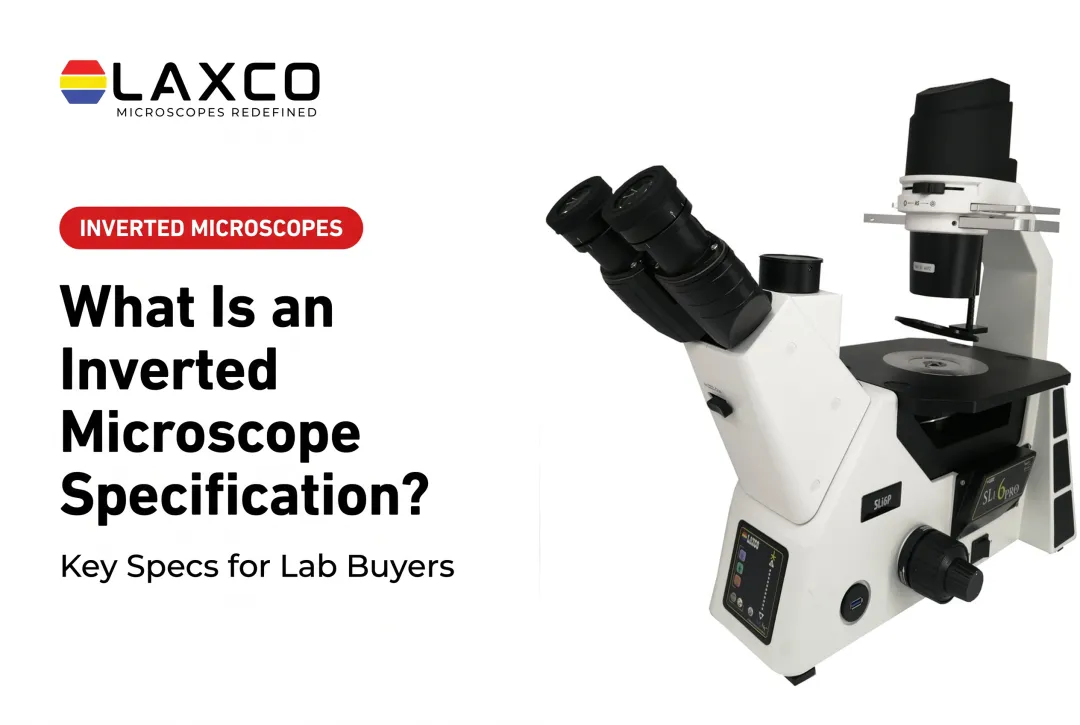
An inverted microscope positions the objectives below the specimen, facing upward. In biological transmitted-light systems, the condenser and transmitted illumination are typically positioned above the specimen so cells can be observed through the bottom of a culture vessel while remaining in their medium. Inverted microscopes can also use reflected-light configurations for opaque materials, where the surface of interest faces downward toward the objectives.

For biological inverted microscopy, this design offers several practical capabilities:
- Imaging cells in dishes, flasks, and multi-well plates without transferring them to slides.
- Open access above the vessel for adding reagents or handling samples.
- Accommodation of culture vessels and larger liquid volumes than conventional slide-based setups.
Biological inverted microscopy also introduces optical considerations because the objective images through the vessel bottom. Bottom thickness and material can affect image quality, and long-working-distance objectives are commonly used to accommodate thicker vessels.
In metallurgical inverted microscopy, the workflow is different. The surface of an opaque specimen is positioned toward objectives below the stage and examined using reflected light, a configuration that can accommodate large or mounted material samples.
Laxco Inverted Microscopes
Laxco's inverted microscope portfolio spans routine biological microscopy, live-cell and fluorescence imaging, large-format cell culture, and industrial materials analysis:
- LMI3000: designed for routine inverted microscopy, including cell and tissue culture applications.
- LMI6000: an inverted platform for cell and tissue culture applications, including live-cell imaging.
- SLi3Pro: field-upgradeable from phase contrast/brightfield to multichannel fluorescence and compatible with common DAPI, FITC, and TRITC fluorochromes.
- SLi6Pro: extends fluorescence coverage from 390-662 nm and supports more than 110 fluorochromes.
- FMI3-CS Series: designed for large-format cell culture, with long-working-distance optics that enable observation of up to 10-layer Cell Factory systems.
- LMI3000MT: an inverted metallurgical microscope for analysis of metals, alloys, ceramics, and other materials, including quality control, welding inspection, failure analysis, and materials research.
Applications of Inverted Microscopes
- Cell and tissue culture: monitoring cell morphology, confluence, and other characteristics while cells remain in culture vessels.
- Embryology and IVF laboratories: observing and manipulating oocytes and embryos in culture dishes.
- Drug discovery and stem cell research: examining cellular responses and other biological processes in culture and multi-well formats.
- Large-format cell culture: inspecting cells in multilayer culture vessels and Cell Factory systems using specialized long-working-distance configurations.
- Metallurgy and materials analysis: examining metals, alloys, ceramics, welds, and other opaque materials for quality control, failure analysis, and research using inverted reflected-light systems.
For laboratories that need automated inverted microscopy with integrated image analysis, Laxco's LEAP AI combines Accuva LEAP optics with Media Cybernetics' Image-Pro AI software for image processing, AI-assisted segmentation, measurement, and reporting through an Image → Process → Measure → Report workflow.
How to Choose Between Inverted and Upright Microscopes
Choosing between inverted and upright configurations depends on how the sample is presented and how the lab needs to work with it. Use the questions below to match the geometry to the application.
- What is the sample geometry and size? Large or mounted metallurgical specimens can benefit from an inverted configuration because the surface of interest can be positioned over objectives beneath the stage. Small slide-mounted biological specimens commonly fit conventional upright workflows.
- How must the sample be mounted or accessed? Culture vessels, dishes, flasks, and multi-well plates favor inverted access from above the stage. Glass slides and prepared sections favor upright objectives above the specimen.
- Which illumination and contrast methods are required? Confirm support for transmitted light, reflected light, phase contrast, fluorescence, polarization, or other methods needed for the workflow.
- What working distance and sample clearance are needed? Thick culture vessels and multilayer cell-culture systems may require specialized long-working-distance optics. For large industrial specimens, consider stage capacity, sample clearance, mounting, and whether the surface of interest can be positioned appropriately for upright or inverted reflected-light observation.
- Is the specimen transparent or opaque? Transparent biological samples often use transmitted-light paths. Opaque metals, alloys, ceramics, and similar materials typically need reflected-light (epi-illumination) configurations available on both upright and inverted metallurgical systems.
Many laboratories use both designs. Upright systems remain standard for slide-based histology and many prepared-sample workflows, while inverted systems serve cell culture, live-cell imaging, and certain materials-inspection tasks where sample size or access favors objectives below the stage.
Frequently Asked Questions
Can an inverted microscope be used for metallurgy?
Yes. Inverted metallurgical microscopes image the polished surface of a sample placed face-down on the stage. Laxco's LMI3000MT is an industrial inverted metallurgical microscope designed for metals, alloys, ceramics, and failure analysis.
Which inverted microscope suits multichannel fluorescence?
The SLi3Pro supports commonly used DAPI, FITC, and TRITC fluorochromes with 3-color multiplex fluorescence. The SLi6Pro extends spectral compatibility from approximately 390-662 nm and supports more than 110 fluorochromes, including options extending into cyan, yellow, and far-red ranges. Choose between them based on the fluorochromes and spectral range required for the workflow.
Can a fluorescence module be added to an existing inverted microscope?
It depends on the model. Laxco's SLi3Pro is designed to be field-upgradeable to fluorescence and digital imaging. For other systems, confirm upgrade options with a Laxco specialist before purchase.
Which microscope suits imaging cells in multi-layer cell culture vessels?
Conventional inverted microscope configurations may not provide the working distance, clearance, or stage geometry required for large multilayer cell-culture vessels. Laxco's FMI3-CS Series is designed specifically for Cell Factory inspection, using long-working-distance optics to observe systems with up to 10 layers while reducing unnecessary sample handling.
What should I compare before requesting a quote?
Compare sample format, required contrast methods, objective range, camera needs, and whether fluorescence or reflected light is required. Sharing these details with a Laxco specialist helps identify a suitable configuration.