
Key Takeaways
- Stabilize RNA promptly after collection to limit degradation.
- Assess RNA integrity and fragment size using metrics appropriate to the sample: RIN is useful for relatively intact RNA, while DV200 is commonly used for FFPE RNA; in highly degraded FFPE samples, shorter-fragment metrics such as DV100 may provide additional information.
- Choose poly(A) selection or rRNA depletion based on RNA integrity and the RNA species of interest.
- For heterogeneous tissue, isolating the target cell population before extraction can reduce signal dilution from other cell types.
RNA Stabilization and Extraction
RNA degradation can begin soon after a sample is removed from its native environment. In one study of rat kidney tissue held at room temperature, measurable ribosomal RNA degradation appeared after 4 hours (PMC). The same study reported yield losses of up to 15% after 24 hours.
Stabilization Methods
- Snap freezing in liquid nitrogen: preserves RNA well when performed quickly after collection.
- Storage at −80 °C: suitable for long-term archiving, although repeated freeze-thaw cycles can degrade RNA.
- RNase-inhibiting lysis buffers: lyse the sample immediately at collection, which avoids a freeze-thaw step.
- Tissue stabilization reagents: permeate tissue and inhibit RNases, allowing short-term storage before extraction according to the manufacturer's conditions.
Blood Samples
Blood contains high RNase activity, so specialized collection tubes containing stabilization reagents are commonly used for RNA work. Stabilization at the point of draw limits changes in expression during transport and storage.
Tissue Heterogeneity
Tissue samples such as tumor biopsies contain several cell types. Bulk extraction combines RNA from all of them, which can dilute the expression pattern of the population of interest. Isolating that population before extraction is discussed in the laser capture microdissection section below.
Assessing RNA Quality and Quantity
RNA Integrity Number (RIN)
The RNA Integrity Number is a 1–10 score calculated from the electrophoretic trace of an RNA sample. Many RNA-seq protocols recommend a RIN above 7 or 8 for standard library preparation (PMC). RIN is a screening metric rather than a strict cutoff, and FFPE samples require a different metric.
Quantitation Methods
| Method | What it measures | Consideration |
|---|---|---|
| Spectrophotometry (A260) | Total nucleic-acid absorbance | Can overestimate RNA when protein, phenol, or DNA is present |
| Fluorometry | RNA-specific dye binding | More specific for low-yield samples; requires additional reagents |
Genomic DNA contamination can inflate apparent RNA yield and interfere with quantification or library preparation. Many RNA-seq workflows therefore include DNase treatment during extraction or cleanup, but the exact requirement should follow the RNA-isolation and library-preparation protocol.
Degradation and 3′ Bias
In poly(A)-selected libraries, RNA degradation can increase 3′ coverage bias because fragments retaining the poly(A) end are preferentially retained while fragments from other parts of the transcript may be lost. Studies comparing degraded samples have found stronger 3′ bias with poly(A) selection than with rRNA-depleted approaches, which can also affect downstream expression estimates (PMC).

Purification Strategy: Poly(A) Selection or rRNA Depletion
Ribosomal RNA makes up the large majority of total cellular RNA. Without removal, it would consume most sequencing reads. Two strategies are commonly used.
Poly(A) selection captures polyadenylated transcripts using oligo-dT beads. It is commonly used when:
- Input RNA has high integrity.
- The target is protein-coding mRNA.
- Non-polyadenylated RNA is not required.
rRNA depletion removes ribosomal RNA using probe-based or RNase H-based methods. It is commonly used when:
- Samples are degraded or FFPE-derived.
- Non-coding RNAs, such as long non-coding RNAs, are of interest.
- RNA integrity is too low for reliable poly(A) capture.
Globin Depletion for Whole Blood
Globin transcripts can make up a large share of whole-blood RNA-seq reads. In one comparison, a globin-depletion method reduced hemoglobin-gene reads to 1.1%, compared with 12.3% without depletion (PMC). The same study reported roughly 800–1,000 additional detectable genes after depletion.

Small RNA Libraries
Small RNA libraries target molecules shorter than about 200 nucleotides, such as microRNAs. They typically use adapter ligation before reverse transcription and strict size selection. These protocols differ substantially from standard mRNA library preparation.
Special Sample Types
FFPE-Derived RNA
Formalin fixation fragments and chemically modifies RNA, so RIN is often uninformative. DV200, the percentage of fragments longer than 200 nucleotides, is commonly used instead. Levin and colleagues recommended random-primed, total-RNA library methods when DV200 falls below 30% (PMC).
Single-Cell RNA-Seq
Enzymatic dissociation at 37 °C can induce stress-response genes, including heat-shock genes, that are unrelated to the biology under study. Approaches to reduce this effect include:
- Cold-active dissociation protocols where suitable for the tissue.
- Minimizing the time between dissociation and capture or fixation.
- Low-input amplification methods matched to single-cell RNA yields.
Laser-Captured Tissue
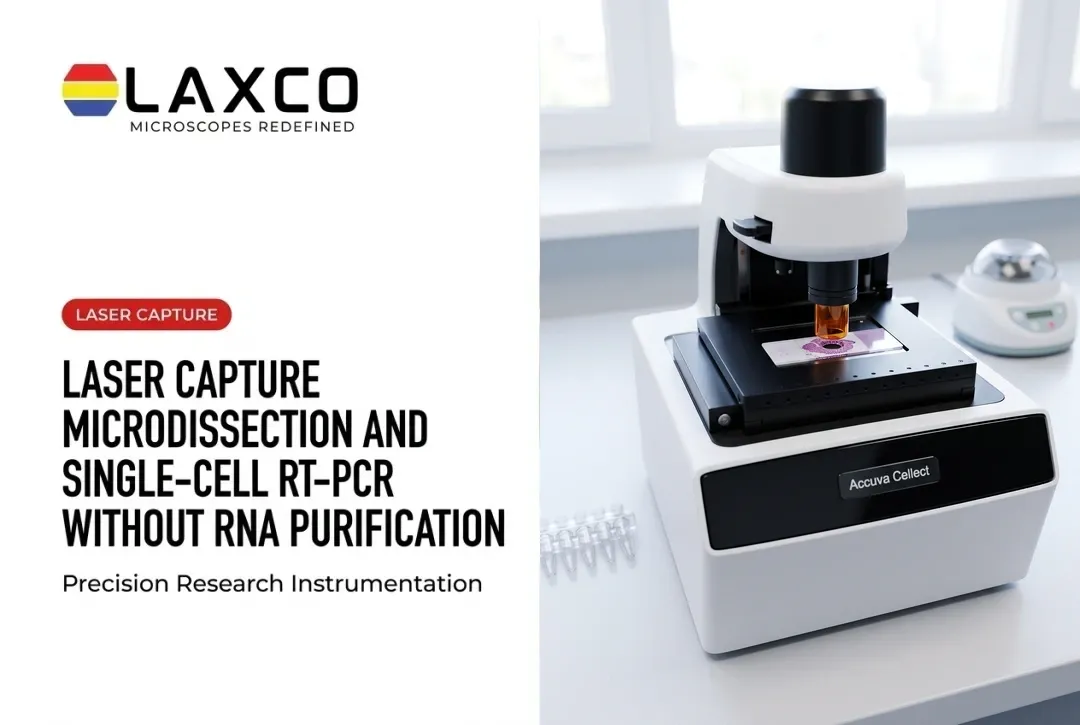
Laser capture microdissection (LCM) isolates defined cell populations from tissue sections under microscopic guidance before RNA extraction. Examples include tumor cells within a heterogeneous biopsy or a specific neuronal layer. LCM retains the link between the RNA sample and the morphology that guided selection. It yields limited RNA, so low-input extraction and library methods are needed.
Laxco's Accuva Cellect Laser Capture Microdissection System supports this workflow:
- An infrared (IR) laser designed for film capture of single cells or small numbers of cells.
- An ultraviolet (UV) laser designed for cutting dense structures, such as bone or plant tissue.
- A five-step software workflow with visual quality control and documentation.
- Documented support for FFPE and fresh-frozen samples, H&E-stained and LCM-optimized stains, immunofluorescence, unstained samples, and cell culture.
Common Pitfalls and a Pre-Library QC Checklist
Common sources of error:
- Delaying stabilization after collection.
- Failing to control genomic DNA contamination when the chosen extraction or library protocol requires DNA removal.
- Using degraded RNA for isoform or splice-variant analysis, where 3′ bias can distort results.
- Over-amplifying low-input samples, which can introduce PCR bias.
Pre-library QC checklist:
- Check RNA quality: use RIN or a comparable integrity metric for relatively intact RNA; for FFPE RNA, use fragment-size metrics such as DV200 and consider DV100 when the sample set is highly degraded.
- Verify concentration with fluorometric quantitation rather than absorbance alone.
- Assess genomic DNA contamination and confirm DNA removal when DNase treatment is part of the validated workflow.
- Assess rRNA or globin content for whole blood or unselected total RNA.
- Record time to stabilization for each sample batch.
A small pilot batch before the full cohort can reveal systematic preparation problems before the main sequencing run.
Frequently Asked Questions
Should I use poly(A) selection or rRNA depletion?
Poly(A) selection suits intact, high-integrity samples focused on coding mRNA. rRNA depletion suits degraded or FFPE samples and studies that include non-coding RNA. The choice should follow RNA integrity and the transcripts of interest.
Can laser capture microdissection samples be used for RNA-seq?
Yes. LCM-isolated material is commonly used for RNA-seq with low-input extraction and library methods. Pilot captures with integrity and yield measurements help determine how much tissue area is needed per sample.
Which sample types does Accuva Cellect support?
Laxco lists FFPE and fresh-frozen tissue, H&E-stained and LCM-optimized stained sections, immunofluorescence, unstained samples, and cell culture. Confirm compatibility with your RNA extraction and library protocol during planning.
What support does Laxco provide for Accuva Cellect users?
Laxco lists training and 48-hour response times as part of its Accuva Cellect support offering.