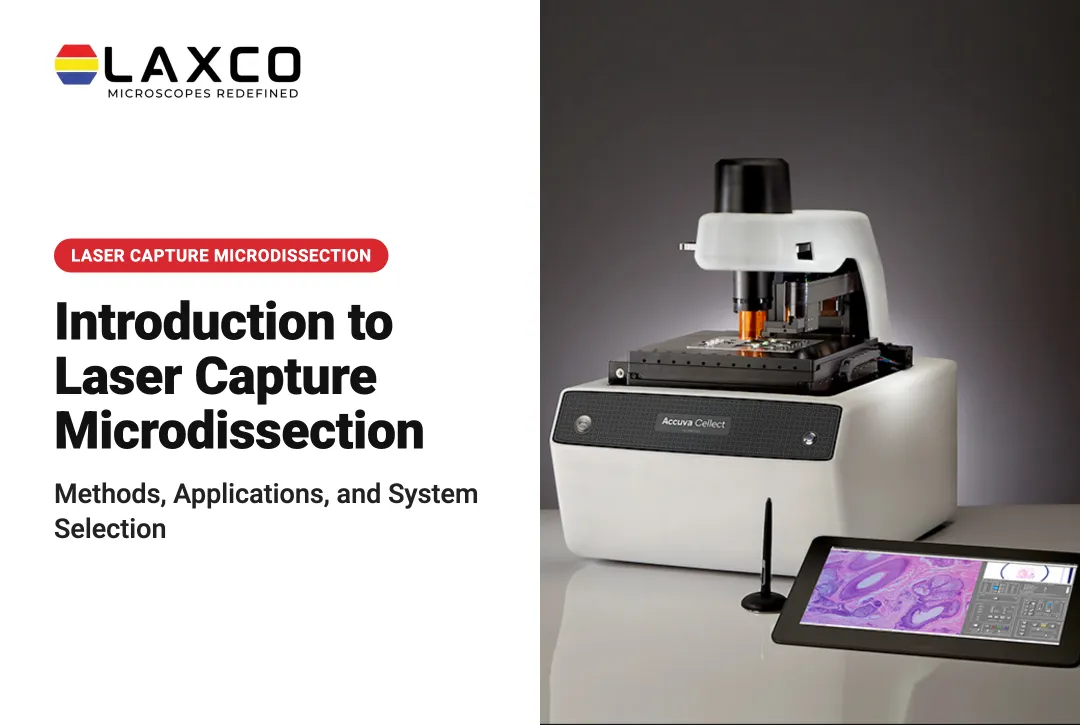

Today, Laxco offers the Accuva Cellect Laser Capture Microdissection System, a dual-laser platform designed to isolate selected cells and tissue regions for downstream molecular analysis. It combines infrared (IR) capture capabilities with ultraviolet (UV) cutting, microscope-guided cell selection, and software-supported quality-control documentation.
This article explains the Arcturus product lineage, how Laxco's current Cellect technology works, and the technical considerations researchers should understand when evaluating an LCM workflow. The historical commercialization relationship is documented in Thermo Fisher's August 2023 business-transfer notice.
Key Takeaways
- Thermo Fisher transferred commercialization of new Arcturus Cellect LCM systems, including service and support, to Laxco in August 2023.
- Laxco's Accuva Cellect combines IR-based cell capture and UV cutting for different tissue-isolation requirements.
- The system supports microscopic identification, selection, and recovery of cells or tissue regions, with a five-step software workflow and visual quality control.
- Researchers can use collected material in separate DNA, RNA, or protein-analysis workflows; Cellect does not itself perform sequencing or mass spectrometry.
- Compatibility with legacy Arcturus accessories or procedures should be confirmed for the particular instrument and workflow rather than assumed.
What Is Arcturus Laser Capture Microdissection?
Arcturus is the name of a specific laser capture microdissection instrument family, not the name of the underlying microdissection technique. Arcturus Bioscience developed early commercial LCM technology, which subsequently became part of Life Technologies and Thermo Fisher Scientific.
The product history is relevant to researchers evaluating Laxco's current technology:
- Earlier Arcturus instruments: included systems such as the ArcturusXT, which Thermo Fisher continues to list in its product catalog. A catalog listing alone should not be treated as confirmation of current purchasing availability, service terms, or configuration options.
- Arcturus Cellect: Thermo Fisher introduced the Applied Biosystems Arcturus Cellect instrument in 2021. In August 2023, the company announced the transfer of commercialization of new Cellect LCM systems to Laxco.
- Laxco Accuva Cellect: Laxco currently markets the Accuva Cellect LCM System, providing a dual-laser tissue-isolation platform for contemporary research workflows.
The Thermo Fisher transfer notice also specifies that Thermo Fisher would continue selling LCM consumables. Researchers using existing Arcturus instruments should confirm the applicable support arrangements and accessory compatibility for their exact system.
The distinction matters: the documented business transfer establishes Laxco's commercial role in Cellect technology, but it should not be interpreted as proof that every older Arcturus instrument, software version, or consumable is interchangeable with today's Accuva Cellect configuration.
How LCM Works
Laxco's Accuva Cellect supports microscopy-guided cell selection and laser-assisted capture as part of a broader microgenomics workflow. The exact preparation and capture parameters depend on the tissue, stain, laser mode, and collection method, but the overall process follows these stages:
- Prepare the tissue section. Use an instrument-compatible FFPE, fresh-frozen, stained, immunofluorescence-prepared, or unstained specimen according to the intended downstream assay.
- Identify the target cells or regions. Examine tissue morphology or marker-based staining under the microscope and confirm the regions that should be isolated.
- Select targets in the software. Document the intended capture regions and use the system's software-guided workflow to prepare for isolation.
- Perform laser-assisted isolation. Use the appropriate IR capture or UV cutting capability for the target and tissue preparation, following the validated operating procedure.
- Inspect and collect the material. Verify capture visually, document the selected and recovered material, and transfer the collected sample into a compatible downstream extraction or stabilization workflow.
Laxco documents a five-step software-guided isolation process and visual quality control for Accuva Cellect. The instrument isolates the selected material; DNA or RNA purification, amplification, sequencing, and protein analysis are separate downstream laboratory steps.
IR Capture and UV Cutting
IR capture: In Arcturus CapSure-style workflows, an infrared laser pulse activates the thermoplastic transfer film on the capture cap so that it adheres to selected cells or tissue regions. IR capture is commonly used for individual cells or small cell populations. Collection mechanics can differ across LCM platforms.
UV cutting: A focused UV laser cuts around a defined region of interest, with recovery of the cut material determined by the platform's collection mechanism. UV cutting can be useful for larger regions and dense tissue structures.
A 2013 comparative study (Vandewoestyne et al., 2013) evaluated specific UV- and IR-based LCM systems and reported beam diameters of about 0.5 µm and 7.5 µm, respectively, for the instruments tested. The authors also reported differences in PCR performance in their low-cell-number experiments. These measurements and performance findings are specific to the systems and experimental conditions studied and should not be treated as universal specifications for UV- and IR-based LCM.

Neither approach suits every application. Target size, tissue properties, collection mechanism, sample preparation, and the downstream assay should guide system selection, and some platforms combine both laser types.
Where Accuva Cellect Fits Into Research Workflows
Accuva Cellect is designed for research requiring physical isolation of cells or tissue regions identified through morphology or staining. By collecting selected material rather than homogenizing an entire heterogeneous section, researchers can reduce the contribution of unwanted cell populations to downstream analysis.
Relevant workflows include:
- Tumor and stromal compartment analysis: isolate morphologically defined cancer cells, stromal regions, or other selected tissue compartments before DNA, RNA, or protein analysis. Earlier prostate cancer research demonstrated the value of LCM for collecting enriched populations for molecular investigation (Rubin et al., 2001).
- Neuroscience and developmental biology: collect defined cell populations or anatomical structures, including regions that are difficult to separate through bulk tissue preparation. Published developmental research has used LCM to isolate mouse embryonic cartilage and mandibular bone regions for gene-expression studies (Wu et al., 2019).
- Archived tissue research: use compatible FFPE preparations to select disease-relevant regions for retrospective molecular studies. The extraction and analytical methods must account for fixation-related damage and low molecular input.
- Targeted downstream molecular analysis: collect selected cells or tissue regions for separately performed qPCR, sequencing, or mass-spectrometry workflows.
These examples illustrate the research applications of LCM as a technique. They do not establish instrument-specific performance results for Accuva Cellect unless a study has directly evaluated that instrument and workflow.
Planning an Accuva Cellect Workflow
When evaluating Accuva Cellect, researchers should focus on the actual tissue-isolation requirements of their experiments rather than comparing laser count alone.
Important questions include:
- Target size and tissue properties: are the specimens composed of small individual cells, larger tissue regions, or dense structures requiring UV cutting?
- Sample preparation: does the intended workflow use FFPE, fresh-frozen, H&E-stained, immunofluorescence-prepared, or unstained tissue?
- Capture mechanism: which compatible collection caps, slides, and other consumables are required for the selected configuration?
- Downstream analysis: will the captured sample undergo DNA extraction, RNA sequencing, RT-qPCR, or proteomics, and are the laboratory's extraction methods suitable for the collected amount?
- Documentation and training: what quality-control records are needed, and which application training and support arrangements are included?
- Laboratory requirements: what instrument space, workstation equipment, service arrangements, and operating conditions should be planned?
Laxco lists ETL certification for Accuva Cellect in North America. The Intertek ETL certification mark relates to compliance with applicable safety standards; it is not evidence of a particular capture yield or downstream assay performance.
Before committing to a workflow, researchers should evaluate the instrument using representative tissue preparations and confirm compatibility with the proposed molecular analysis.
Accuva Cellect: Laxco's Current LCM Technology
The Accuva Cellect Laser Capture Microdissection System is Laxco's current offering for research laboratories that need microscope-guided isolation of individual cells, small cell populations, or defined tissue regions.
Its documented dual-laser configuration supports different target-isolation requirements, while software-guided selection and visual quality-control features assist with workflow consistency and documentation.
The system supports tissue collection as part of broader microgenomics and proteomics workflows. Researchers perform nucleic-acid purification, amplification, sequencing, protein extraction, and mass spectrometry through separately selected downstream laboratory methods.

Accuva Cellect provides:
- IR laser: designed for film capture of single cells or small numbers of cells.
- UV laser: designed for cutting dense structures, such as bone or plant tissue.
- A five-step software workflow with visual quality control and documentation.
- Documented sample types: FFPE and fresh-frozen tissue, H&E-stained and LCM-optimized stains, immunofluorescence, unstained samples, and cell culture.
- CapSure LCM caps within the capture workflow. Captured material can proceed to DNA or RNA extraction for workflows such as qPCR and NGS, or to protein extraction for downstream mass spectrometry.
- A compact footprint, which Laxco states is approximately 32% smaller than comparable microscope-and-laser systems.
- ETL certification by Intertek.
- Support: training and 48-hour response times.
The Cellect Grant Assistance Program provides Grant Language Kits for NIH, NSF, HHMI, and DOD proposals that include LCM.
Evaluation Checklist
| Factor | Questions to ask |
|---|---|
| Laser modes | Does the system offer IR capture, UV cutting, or both? |
| Capture method | Which caps, films, or tubes are used, and what do consumables cost? |
| Software | Does it support QC documentation and operator traceability? |
| Sample flexibility | Does it work with your current stains and slide types? |
| Support | What training is included, and what is the service response time? |
Run a pilot with your own tissue and stains before purchasing. Performance on a demonstration slide may differ from performance on your samples.
Frequently Asked Questions
Is Arcturus LCM still available?
The Arcturus product family includes multiple instrument generations. Thermo Fisher continues to maintain an ArcturusXT product listing, but a catalog listing does not by itself confirm current instrument availability.
For new Cellect systems, Thermo Fisher's August 2023 notice transferred global commercialization, service, and support responsibilities to Laxco. Researchers evaluating a current system can review Laxco's Accuva Cellect.
For existing instruments, confirm the applicable model-specific accessories, consumables, software compatibility, and support arrangements directly with the relevant supplier.
Which sample types does Accuva Cellect support?
Laxco lists FFPE and fresh-frozen tissue, H&E-stained and LCM-optimized stained sections, immunofluorescence, unstained samples, and cell culture. Confirm compatibility with your downstream assay during planning.
Does Accuva Cellect use CapSure caps?
Yes. Laxco's Accuva Cellect workflow uses CapSure LCM caps for capture. Captured material can proceed to DNA or RNA extraction for workflows such as qPCR and NGS, or to protein extraction for downstream mass spectrometry.
How much bench space does Accuva Cellect need?
Accuva Cellect has a compact footprint, which Laxco states is approximately 32% smaller than comparable microscope-and-laser systems. Confirm dimensions with a Laxco specialist.