
Key Takeaways
- LCM systems are generally priced by quote, because configurations vary between laboratories.
- Laser configuration, optics, automation, and software are the main drivers of system cost.
- Recurring costs include consumables such as LCM caps and slides, software renewals, and service contracts.
- The right configuration depends on application, sample volume, and required precision.
- Laxco offers a Cellect Grant Assistance Program with Grant Language Kits for NIH, NSF, HHMI, and DOD proposals.
How LCM Systems Are Priced
LCM instruments are generally priced through supplier quotations rather than standardized public price lists. Buyers should request pricing that reflects the instrument's documented laser capabilities, optics, software, accessories, installation, and service arrangements. Exact costs depend on the selected system and purchasing agreement.
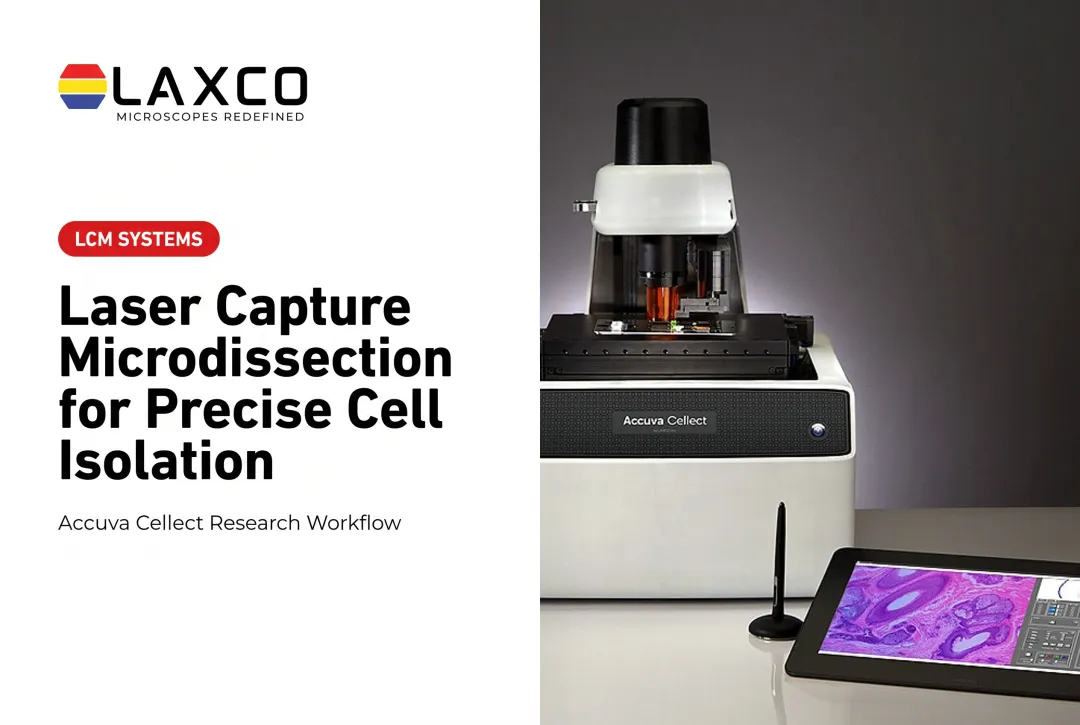
Laxco provides pricing for its Accuva Cellect Laser Capture Microdissection System through product information requests. No verified public purchase price is listed on the product page, so a laboratory should obtain a formal quotation rather than rely on an estimated equipment price.
Purchase Price vs. Core Facility Access
Purchasing an LCM instrument is not the only way to access the technology. Some universities and shared microscopy facilities charge researchers for instrument use by the hour.
For example, Duke University's Light Microscopy Core Facility lists an internal laser capture microdissection equipment-use fee of $29.85 per hour, effective July 1, 2026. This is a subsidized institutional usage rate for a different LCM system - not a purchase price for Accuva Cellect, a nationwide market rate, or a commercial laboratory-service quote. Access eligibility, training, consumables, and additional charges depend on the facility.
Labs with occasional LCM needs may compare available core-facility access with ownership costs. Laboratories expecting regular use should evaluate whether purchasing a dedicated system offers greater scheduling flexibility and control over sample handling.
Configuration Categories
The scenarios below are illustrative planning examples, not Accuva Cellect product tiers or published price bands:
- Occasional-use laboratories: fewer automated functions and more operator involvement. They can suit lower sample volumes and intermittent capture needs.
- Regular-use laboratories: software-guided workflows and more consistent capture. They suit laboratories running LCM as a recurring part of study design.
- High-volume laboratories: more automation and optional image-analysis tools. They suit laboratories processing many samples and prioritizing throughput.
Use these scenarios to identify purchasing priorities rather than assuming that all suppliers offer the same configuration levels.

Factors That Affect LCM Cost
Laser Configuration
LCM systems use infrared (IR) thermoplastic-film capture, ultraviolet (UV) cutting, or both. In IR thermoplastic-film capture, a thermoplastic film is melted onto selected cells and lifted from the slide. In UV cutting, the laser cuts around the region of interest and the excised piece is collected. Both methods can support small targets, including individual cells, when the optics and workflow allow it; UV cutting is also used for larger regions and dense structures. Accuva Cellect combines IR for single cells and small cell populations with UV for dense structures such as bone or plant tissue.
Optics and Imaging
Objective quality, illumination options, and camera performance affect how clearly targets can be identified before capture. Fluorescence capability matters when targets are identified by immunofluorescence.
Software and Image Analysis
Capture software handles target selection, laser control, and documentation. Accuva Cellect uses a five-step software workflow with visual quality control.
For separate microscopy image-analysis requirements, Laxco's LEAP AI combines Accuva LEAP optics with Media Cybernetics Image-Pro AI for pre-trained deep-learning segmentation, batch processing, measurement, and reporting. LEAP AI is not a built-in Accuva Cellect target-selection or capture-control feature. Laboratories considering both platforms should request itemized pricing and confirm licensing terms and workflow compatibility with Laxco.
Safety Certification and Intended Use
Accuva Cellect is ETL certified for North America, with Intertek certification for compliance with applicable UL/CSA safety standards. Electrical safety certification is separate from diagnostic regulatory clearance. Buyers should confirm the intended-use status of any system before planning clinical applications.
Installation, Training, and Support
Installation, calibration, and training may be included in the purchase price or quoted separately, depending on the supplier and agreement. Laxco lists training and 48-hour response times for Accuva Cellect. Buyers should confirm the available training formats, installation requirements, service coverage, response terms, and any additional charges before approving the quotation.
Consumables and Maintenance
Recurring costs include slides, collection caps, and tubes. CapSure LCM caps are among the consumables used in Laxco's LCM workflow. Annual service and calibration should be confirmed as separate line items.
Total Cost of Ownership
| Component | Type | Typical contents |
|---|---|---|
| Initial purchase | One-time | System, lasers, optics, standard software |
| Installation and setup | One-time | Site preparation, calibration, initial training |
| Software and licensing | One-time or recurring | Capture software, optional image-analysis software |
| Consumables | Recurring | LCM caps, slides, tubes, reagents |
| Service | Recurring | Service contracts, calibration, repairs |
| Upgrades | Periodic | Software updates, optional modules |
Comparing quotations using the same cost categories helps laboratories evaluate the full financial commitment rather than only the purchase price.
Total cost of ownership = initial equipment and setup costs + consumables + software and service expenses + anticipated upgrades over the planning period.
For cost-per-sample planning, estimate total expenses over the planning period, including amortized equipment and setup costs, staff time, consumables, software, service, and failed or repeated captures. Include downstream extraction or analysis where relevant. Divide these expenses by the expected number of usable samples, rather than total capture attempts. Laboratories can compare the resulting estimate with core-facility access fees, such as Duke's internal LCM rate noted above, while recognizing that subsidized facility fees do not represent commercial purchase pricing.
Matching the System to the Application
Before requesting a quote, define:
- Application: oncology, neuroscience, developmental biology, or other research areas, and the downstream assays.
- Targets: single cells, small groups, or larger regions, and whether dense tissue must be cut.
- Sample types: FFPE, fresh-frozen, stained, immunofluorescence, unstained, or cell culture. Laxco lists all of these for Accuva Cellect.
- Sample volume: occasional use or daily processing.
- Bench space: Laxco describes Accuva Cellect as having a footprint approximately 32% smaller than comparable microscope-and-laser systems. Request the exact dimensions and installation requirements for the selected configuration.
- Support needs: training, installation, warranty, response times, and service-contract terms. Ask suppliers to itemize these elements in the quotation so laboratories can compare coverage and ongoing costs on the same basis.
Funding an LCM Purchase
LCM instruments are often purchased with grant funding. Laxco's Cellect Grant Assistance Program supports researchers who want to include Accuva Cellect in NIH, NSF, HHMI, or DOD proposals. It includes "Grant Language Kits" with technical microscope specifications and a 15-minute "Grant Fit" consultation.
The program is intended for early-career investigators, core facility directors, SBIR/STTR applicants, and other researchers. The researcher provides the research goals and pilot data, and Laxco provides technical specifications and grant support.
Frequently Asked Questions
How do I get pricing for Accuva Cellect?
Laxco provides Accuva Cellect pricing through product information requests. Describe your applications, sample types, sample volume, and required training so that the quote reflects the configuration, consumables, and support you need.
Which recurring costs should I include in an LCM budget?
Include collection caps such as CapSure LCM caps, slides, extraction and amplification reagents, any software renewals, and service or calibration contracts. Request these as separate line items so quotes can be compared on the same basis.
Does Laxco help with grant applications for LCM equipment?
Yes. The Cellect Grant Assistance Program provides Grant Language Kits with technical specifications and a 15-minute Grant Fit consultation. It supports NIH, NSF, HHMI, and DOD proposals that include Accuva Cellect.
How much bench space should I plan for Accuva Cellect?
Laxco describes Accuva Cellect as having a footprint approximately 32% smaller than comparable microscope-and-laser systems. Confirm the exact dimensions for the selected configuration, and allow space for the instrument, control equipment, sample preparation, and consumables.
Is training included with an Accuva Cellect purchase?
Laxco lists training and 48-hour response times for Accuva Cellect, but the specific training format and what is included in a purchase should be confirmed in the quotation. Ask about initial operator training, installation assistance, additional training costs, and service coverage before scheduling study samples.